Skip to content

Frontend Developer / Web Applications

Abu Abdullah Md Iqram

Chattogram, Bangladesh

I build interfacesthat become complete products.

I build responsive React and Next.js products, with a particular interest in commerce and the connection between interface, API, and data.

I would rather ship the whole thing than hand over a screen and wait. If the data model or the API is what stands between an idea and something usable, that is part of the work for me.

Application layers

4 rings

Rings run outward in, interface to integrations. A simplified view of the shape of the work, not a claim that every project uses every layer.

Portrait of Abu Abdullah Md Iqram

AAMIQRAM — Frontend Developer

// Who is behind this

The person behind the interface

My name is Abu Abdullah Md Iqram. I am a frontend developer in Chattogram, and most of my work sits in the layer people do not usually photograph: the API behind a screen, the data model under that, and whether either of them still makes sense when a real person with a real order tries to use it.

I did not come to this by a straight route. I started a BSc in Mathematics at Chittagong College in 2023, and picked up programming alongside it because I wanted to see whether the thing I was studying could be made to do anything. What kept me in it was not the theory but the moment an idea stops being a screen and becomes something a person can actually use.

The part I enjoy most is the seam between the interface and the data. A checkout that has to survive a failed request. An order that is only allowed to become paid when the payment gateway says so. An inventory record that two people editing at once cannot corrupt. None of that is visible in a screenshot, and all of it decides whether the product is real.

So I build the whole thing rather than the front of it. The work in this portfolio is mostly commerce — marketplaces, catalogues, checkout, delivery rules. I am still early in my career and I say so throughout this site, but I am ready to take a feature end to end and to keep learning in that layer.

Primary stack

  • React
  • Next.js
  • JavaScript
  • TypeScript
  • Tailwind CSS
  • Node.js
  • Express.js
  • PostgreSQL
  • Prisma
  • MongoDB
  • JWT
  • Zod
  • Firebase
  • Git

// Capabilities

What I work on

My specialisation is the interface. The rest of these areas exist because a product needs them to work, not because I am claiming to be primarily a backend engineer.
  • Frontend Engineering

    The primary specialisation. Interfaces that stay readable and usable from a 320px phone to a wide desktop.

    • Responsive interfaces built with CSS Grid, Flexbox and Tailwind CSS
    • React and Next.js application development
    • Component composition and genuinely reusable UI
    • Server state with TanStack Query, client state kept separate
    • Semantic HTML, keyboard access and visible focus
  • Full-Stack Application Development

    Connecting a frontend to a service that behaves predictably, so the whole product can be reasoned about.

    • REST APIs and multi-step application workflows
    • Node.js and Express service layers
    • Authentication and role-based authorisation
    • Media upload and transactional email pipelines
    • Deployment as serverless functions on Vercel
  • Data Modelling & Persistence

    Choosing the store that matches the domain, then making the schema do the integrity work.

    • PostgreSQL with Prisma for relational domains
    • MongoDB with Mongoose for document-shaped domains
    • Modelling orders, line items, variants and stock
    • Input contracts with Zod at the route boundary
    • Pricing and eligibility rules as pure functions
  • Authentication & Access Control

    Identity and permissions, with the API as the only authority and validation at the edge.

    • JWT-based authentication and cookie handling
    • Role-based access for customer, seller and administrative paths
    • Request payload validation with Zod schemas
    • Secret and publishable key separation between client and server
    • Honest scope: application-level access control, not a security audit
  • Integrations & Real-Time Features

    Third-party services wired into a usable interface, rather than sitting behind it.

    • Payment checkout with Stripe and SSLCommerz
    • Local payment methods surfaced in the checkout flow
    • Socket.IO for live order and notification events
    • Cloudinary and Multer for product media
    • Transactional email for order and account flows

Wondering whether a specific technology is in scope? See the full inventory.

// Selected work

Projects, with the engineering shown

Each entry states how its claims were established. Where a source could be read, it was; where it could not, that is said plainly.
Team projectLive on VercelSource verified

Unity Shop — case study

A multi-vendor marketplace, built on Next.js with real-time order updates.

A team-built marketplace covering 22 product categories, twelve currencies, seller onboarding, flash-sale countdowns and a real-time order surface. The published frontend talks to MongoDB directly from Next.js route handlers.

  • Next.js
  • React
  • Node.js
  • Express.js
  • MongoDB
  • +4 more

Read from the package manifests of both public repositories, and from the server-rendered homepage of the deployed site.

Unity Shoplive capture
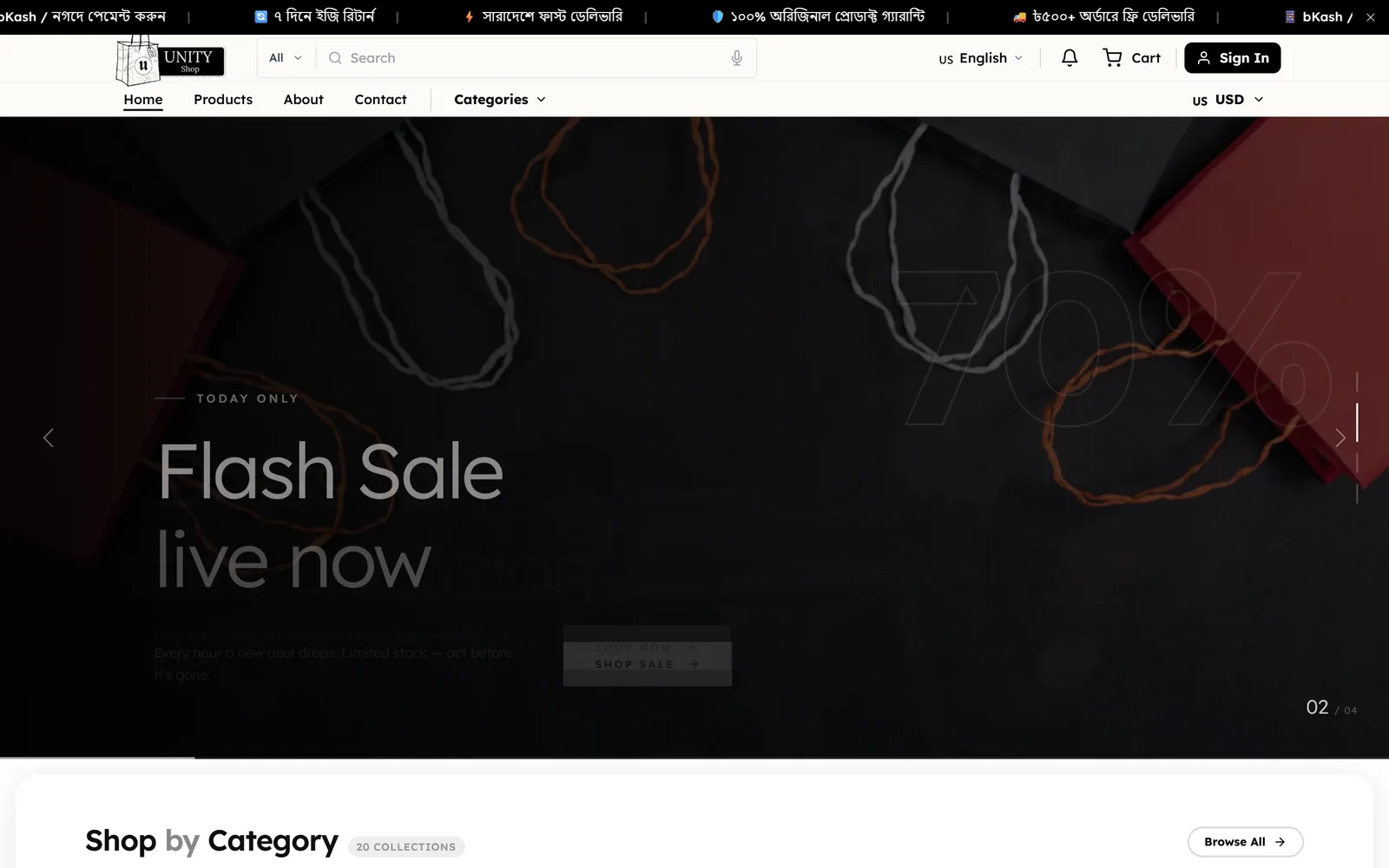
The deployed Unity Shop storefront: a top announcement bar over a banner carousel, a row of product category tiles, and a grid of discounted product cards with prices in taka.
Individual projectLive on VercelReported, not verified

Your Iyanat — case study

A jewellery storefront built for the Bangladeshi market, with checkout and after-sales workflows.

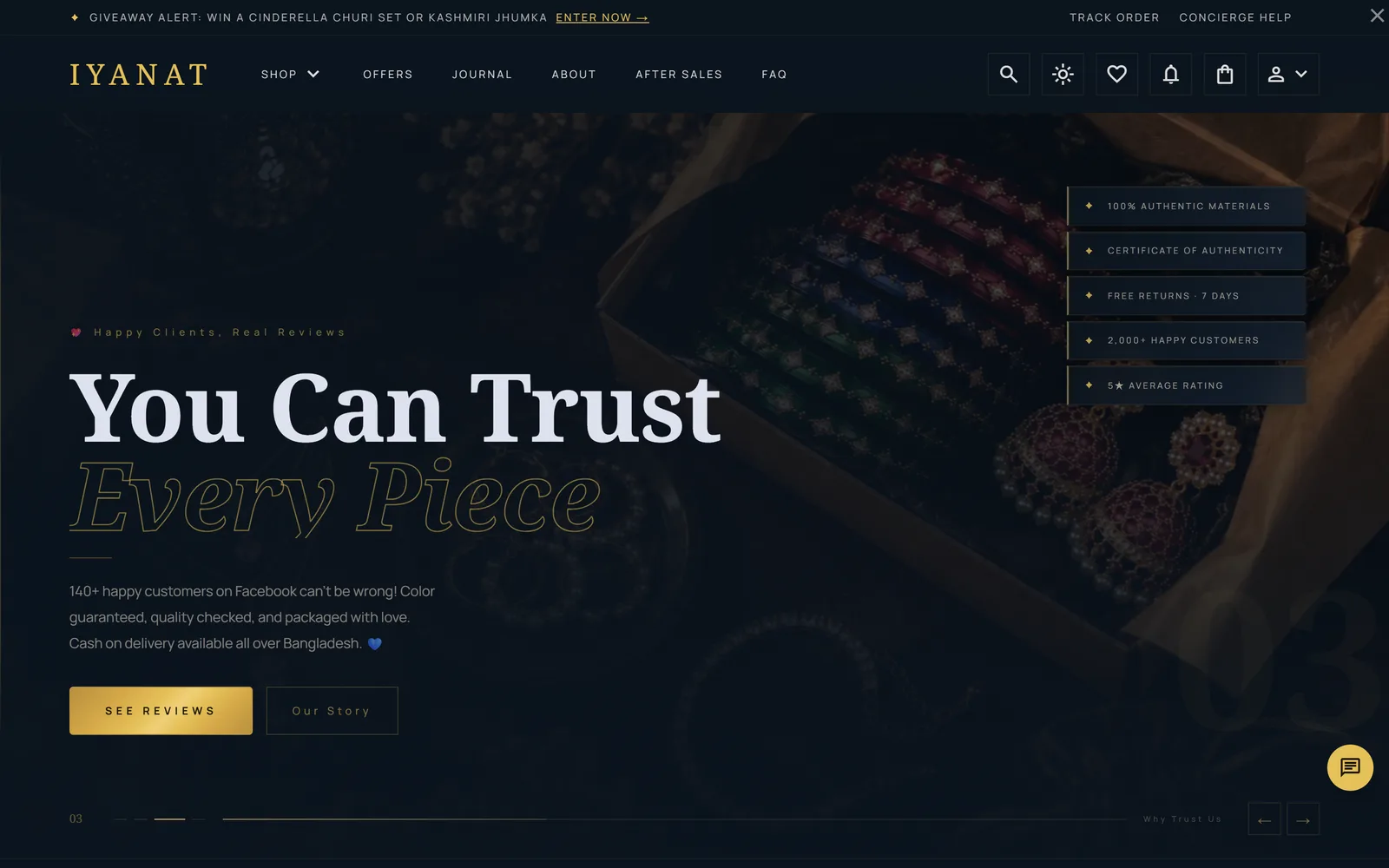
An individual e-commerce build for a luxury ornament retailer: six jewellery categories, Taka pricing, four-zone delivery, coupon and flash-sale logic, order tracking and an after-sales surface, backed by a PostgreSQL database modelled with Prisma.

  • Next.js
  • React
  • TypeScript
  • Node.js
  • Express.js
  • +4 more

The deployment is public and was inspected, but the frontend and backend repositories are not published, so the data model and API internals could not be read.

Your Iyanatlive capture
The deployed Your Iyanat storefront: an offers and giveaway banner above a hero section with jewellery collection imagery, followed by category tiles for bracelets, earrings and necklaces.
Individual projectLive on Vercel, API on VercelSource verified

Local Chef Bazaar — case study

A full-stack food marketplace connecting customers with home cooks.

A marketplace built as a React single-page app on Vite, talking to an Express and Mongoose API. Menu browsing, ordering, reviews, role-based workflows, Stripe checkout and Firebase-backed authentication and storage.

  • React
  • Vite
  • React Router
  • Tailwind CSS
  • TanStack Query
  • +5 more

Both repositories are public. Every technology listed was read from their package manifests, and the deployed site was inspected.

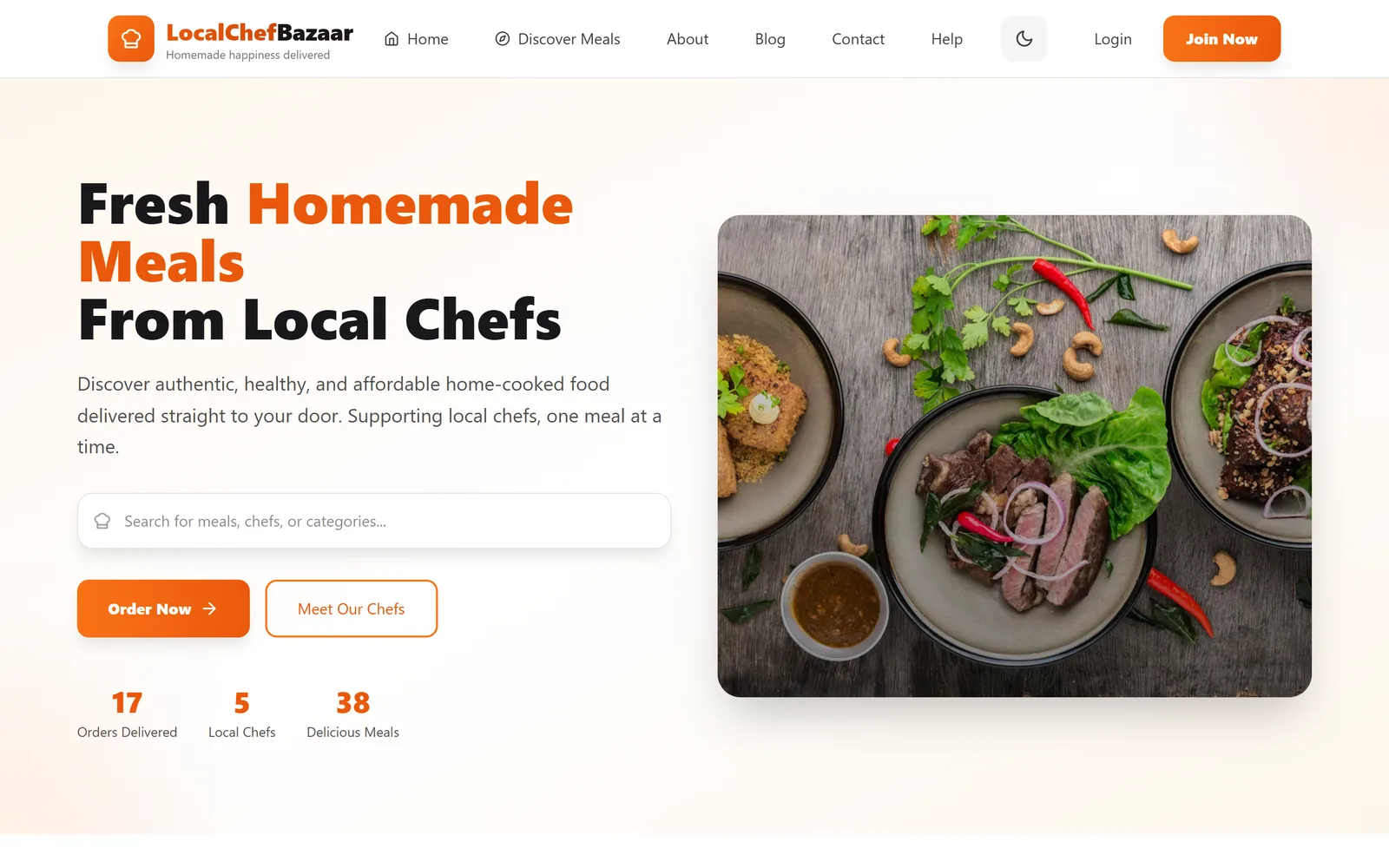
Local Chef Bazaarlive capture
The deployed Local Chef Bazaar homepage: the LocalChefBazaar wordmark and navigation above a 'Fresh Homemade Meals From Local Chefs' hero panel, a 'How It Works' section, and cards for individual chefs and meals.
Personal projectLive on Firebase HostingReported, not verified

FinEase — case study

A personal finance manager for expenses, budgets and savings goals.

A full-stack finance tracker where the interface is the product: entry forms, category breakdowns and budget progress are the three screens that matter, and they are the three I spent the most time on.

  • React
  • Node.js
  • Express.js
  • MongoDB
  • JWT
  • +1 more

The repository is public and the deployment is live, so the landing page and sign-in flow can be checked directly. I have not written a deep case study here because I would be describing my own earlier coursework rather than a decision I would defend today.

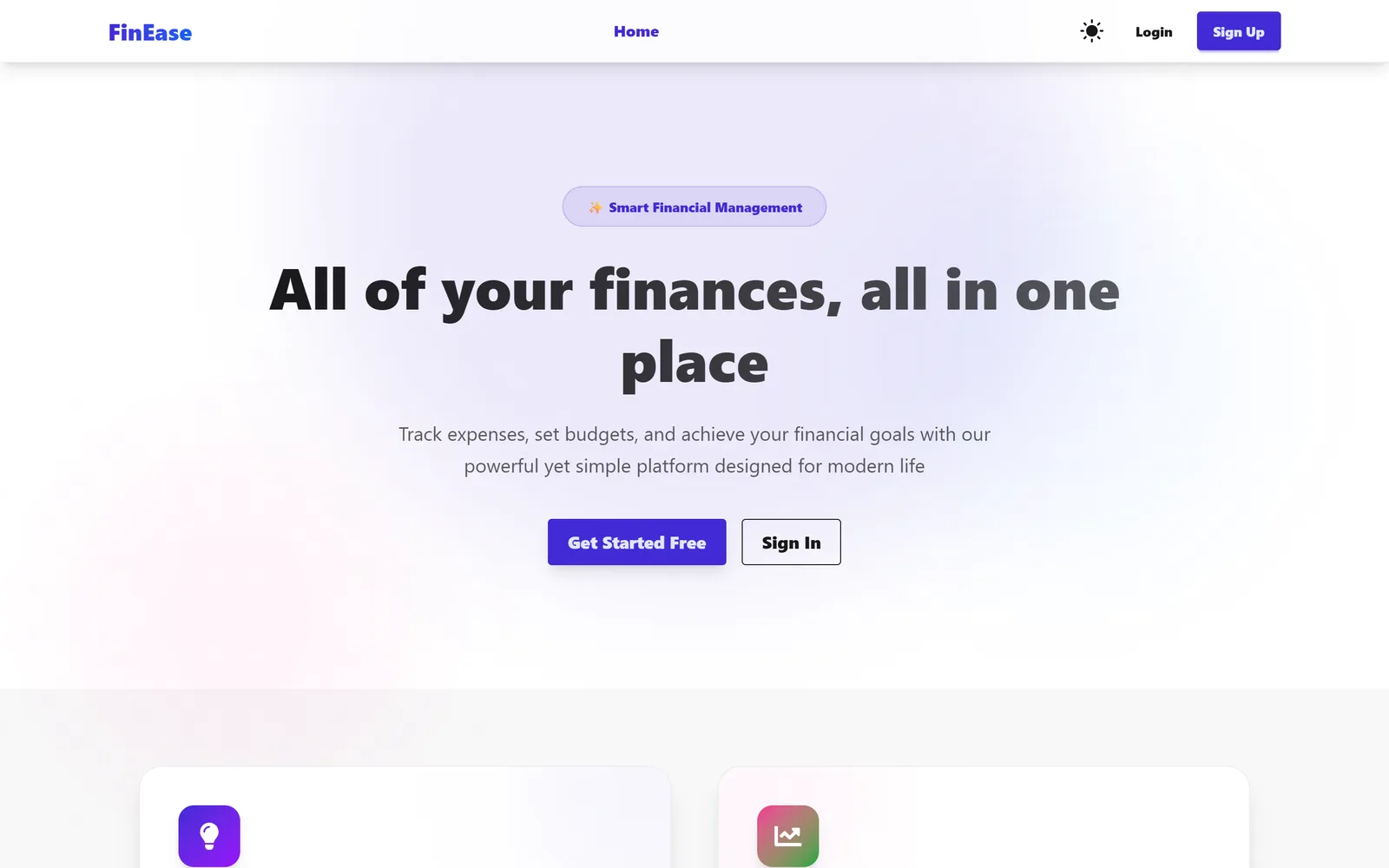
FinEaselive capture
The deployed FinEase landing page: a 'Smart Financial Management' badge above the headline 'All of your finances, all in one place', a sign-in and sign-up panel, and a row of smart budgeting tips.

See the other 2 projects

// How I approach it

Engineering is a set of habits, not a stack

Three positions I keep coming back to, each argued in full in one of the notes below.
  • 01 — Data

    Work out the model before the screen

    What an order is, what a variant may contain, what the database should refuse to store. Get that right and the interface usually writes itself.

    Read the note
  • 02 — APIs

    Validate once, at the boundary

    Parse the payload into a typed value at the route edge, then pass only that value inward. A handler should never trust a field the client did not send.

    Read the note
  • 03 — Interfaces

    Server state is not client state

    One is authoritative in the database and cached by key. The other is authoritative in the browser. Treating them the same is how a data fetch becomes a rendering bug.

    Read the note

// Engineering notes — the reasoning, at length

// Education & learning

How I got here, and what I am doing now

Two of these are still running. Nothing below is a completed qualification or a past role — it is the route, in the order it happened.

  1. 2023

    Ongoing

    BSc in Mathematics

    Chittagong College

    An undergraduate degree in mathematics, taken alongside the programming work rather than before it. Proofs, stated assumptions, and being told precisely where a claim stops being true.

    It trained the habit this portfolio keeps returning to: an interface bug is very often an assumption nobody checked.

  2. 2025

    Ongoing

    MERN Stack Web Development

    Programming Hero

    Full-stack web development coursework with a real scope per assignment: an Express and MongoDB API behind a React client, then Stripe checkout, then Firebase-backed authentication.

    Most of the projects in the directory came out of it. The coursework supplied the structure; the parts I kept were the decisions about where data lives and what the API is allowed to assume.

  3. Now

    Current

    Building whole products, not screens

    Chattogram, Bangladesh

    Working end to end: the interface, the API, the schema and the deployment. Right now that means commerce — catalogues, checkout, delivery rules, order state — and the occasional native application when I want to understand a platform other than the browser.

    I am looking for work where I can own a feature end to end and keep learning in the layer between the interface and the database.

The longer version, including how I decide where data should live, is on the about page.

// Get in touch

Have a project that needs a real interface?

I am a Frontend Developer working on React and Next.js applications, and comfortable owning the backend and data layers when a product needs them. The fastest way to reach me is email.
Based in
Chattogram, Bangladesh
GitHub
github.com/aamiqram(opens in a new tab)
LinkedIn
linkedin.com/in/aamiqram(opens in a new tab)